
As a therapist, I often see my clients navigating the rollercoaster of attachment anxiety in their relationships. It’s like having a clingy friend in your head who keeps whispering, “Are they really into me? Will they stay? Am I worthy of love?” It’s time to address this emotional adventure and understand how our early experiences shape our adult connections.
Let’s delve a bit deeper into what attachment styles are all about. Attachment theory, developed by renowned psychoanalyst John Bowlby, explores the emotional bonds formed between children and their primary caregivers. Bowlby observed that infants rely on their caregivers for comfort, support, and protection when faced with distressing situations. These early experiences become the foundation for our attachment styles, which influence how we approach relationships throughout our lives.
I want to emphasize that attachment styles aren’t set in stone. They can vary in degree rather than being fixed categories. So, while our early experiences matter, we have the power to change and evolve in our relationships.
Now, let’s meet Mary Ainsworth, who expanded on Bowlby’s work by developing the “Strange Situation Protocol.” This research assessed attachment patterns in young children by observing their reactions to separations and reunions with their caregivers. Ainsworth identified three main attachment styles:
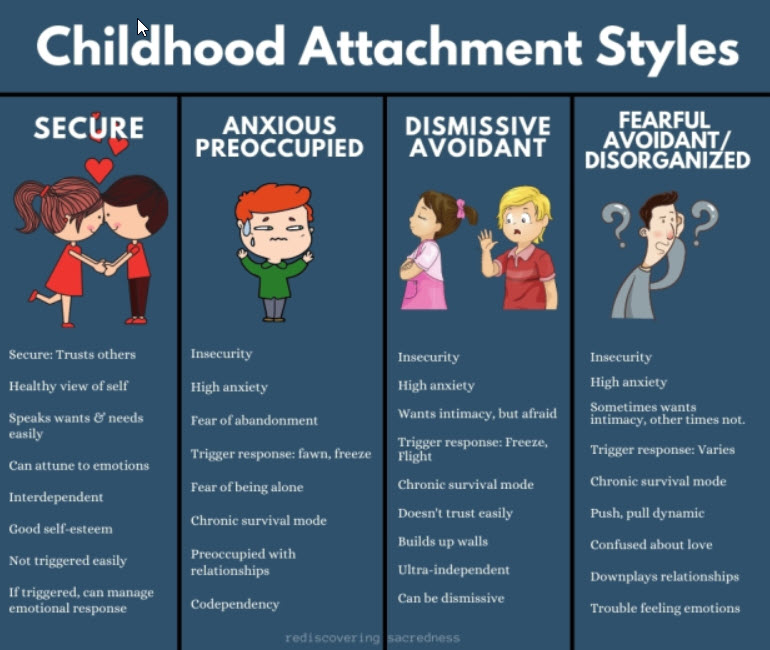
- Secure Attachment: Children with secure attachment feel confident and comfortable exploring their environment because they know they have a reliable and supportive caregiver to return to when needed. As adults, those with a secure attachment style tend to form healthy and stable relationships, feeling secure in their partner’s love and support.
- Anxious-Resistant Attachment: Children with this attachment style may become overly dependent on their caregivers and be excessively clingy. They often experience high levels of anxiety when separated from their caregivers. As adults, those with an anxious-resistant attachment style may seek constant reassurance and validation from their partners, fearing abandonment and questioning their partner’s love.
- Avoidant Attachment: Children with avoidant attachment may appear independent and dismissive of their caregivers. They may avoid seeking comfort or support when distressed. As adults, those with an avoidant attachment style might struggle to fully trust and rely on their partners, keeping emotional distance and avoiding intimacy.
- Fearful Attachment (Disorganized Attachment): Ah, the elusive fearful attachment style! This is like the love story with plot twists and turns that keep you on the edge of your seat. Children with fearful attachment exhibit conflicting behaviors, feeling both a desire for closeness and a fear of intimacy. As adults, they may struggle with intense emotional ups and downs in relationships, alternating between seeking connection and pulling away out of fear of rejection or hurt.
Let’s take Jane as an example of someone with an anxious-resistant attachment style. Whenever she starts dating someone new, she becomes consumed by thoughts of whether they really like her or not. She constantly seeks reassurance from her partner, asking for verbal affirmations and affirmations through actions. If her partner doesn’t respond instantly to a text, her anxiety goes through the roof, and she imagines all kinds of worst-case scenarios. The fear of being abandoned or rejected is overwhelming, driving her to hold on tightly to the relationship.
On the other hand, let’s meet Tom, who exhibits an avoidant attachment style. Tom has always been an independent and self-reliant person. He values his personal space and avoids showing vulnerability in relationships. When things get too intimate or emotionally intense, he withdraws, pushing his partner away. Tom finds it challenging to fully open up and trust others, which often leads to misunderstandings and feelings of rejection in his relationships.
And then there’s Megan, who embodies the fearful attachment style. Megan craves deep connections and intimacy, but at the same time, she fears getting hurt or rejected. This inner conflict causes her to experience intense emotional highs and lows in her relationships. She may push her partner away when things get too close and then desperately seek reconnection, leading to a cycle of emotional turbulence.
Understanding our attachment styles can offer valuable insights into how we relate to others in both romantic and non-romantic relationships. Remember, attachment styles aren’t destiny; they can be worked on and evolved with self-awareness and effort. I encourage my clients to explore and challenge their attachment patterns to create healthier and more fulfilling relationships.
References:
- Bowlby, J. (1982). Attachment and Loss: Volume 1. Attachment. Basic Books.
- Ainsworth, M. D. S., Blehar, M. C., Waters, E., & Wall, S. (1978). Patterns of Attachment: A Psychological Study of the Strange Situation. Lawrence Erlbaum Associates.
 Caronleid