
This isn’t my usual content, but I decided to dust off my MBA and break this down. Economics has a big impact on our mental health, so we can’t ignore it. With rising interest rates, increasing immigration, and a crazy housing market, many Canadians are worried about our future. It feels like we’re stuck in a long, dark tunnel with no end in sight. Is this a recession or stagflation? I’m not sure, but let’s figure this out together.
Canada’s economy, measured by how much money each person makes on average (called GDP per person), hasn’t bounced back to its pre-pandemic level and has actually been going down. This drop in productivity is worrying for our future standard of living, especially compared to the United States, which is both our main trade partner and economic competitor.
Over the past few decades, Canada’s economy has grown slower than the U.S. While both countries have seen growth, the gap between them has widened. From 1981 to 2022, Canada’s GDP per person grew by 59%, while the U.S. saw a 98% increase. This means that in 1981, Canada’s GDP per person was about 90% of the U.S.’s, but by 2022, it had fallen to just over 70%.
This decline happened in three phases: a drop from 1981 to the mid-1990s, a period of stability at around 80% from the mid-1990s to 2014, and then another drop to the present level.
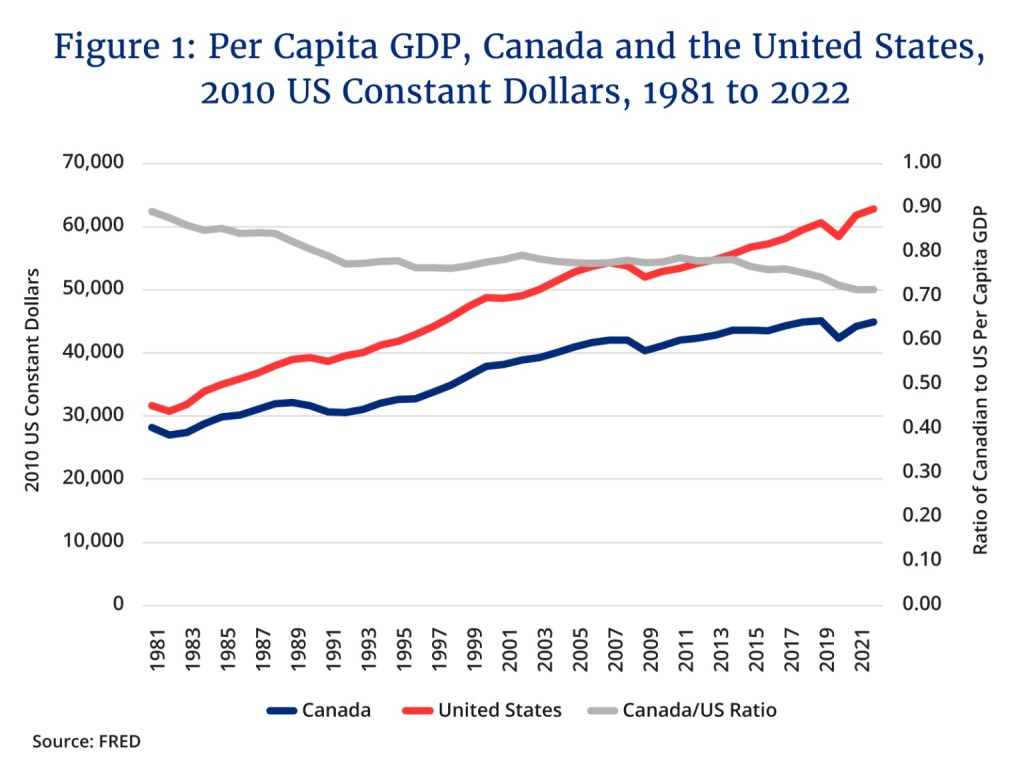
Historically, from the 1870s to the early 1980s, Canada’s GDP per person grew relative to the U.S., peaking at nearly 90%. But in the past four decades, we’ve regressed to where we were in the 1870s. There are some regional differences though: provinces like Alberta, Saskatchewan, and Newfoundland and Labrador have done better due to their natural resources, and cities like Quebec City, Vancouver, and Montreal have seen larger GDP increases than Toronto, Calgary, and Edmonton.
Five main factors contribute to Canada’s lagging productivity:
- Population Growth: Canada’s population is growing rapidly, mainly due to high immigration, including international students and temporary workers. This growth is the highest since the 1950s. In 2023, Canada’s population hit a record 40.528 million, up by a million from the previous year. Economic growth can be extensive (total GDP increase) or intensive (GDP increase per person). For GDP per person to grow, GDP must increase faster than the population. Canada’s population has been growing faster than the U.S., which affects our GDP per person negatively.
- Capital Investment: While Canada’s investment in buildings, machinery, and equipment is respectable as a share of total GDP (23% compared to the U.S.’s 21%), when you look at investment per person, Canada falls short. In 2022, the U.S. spent more per person on investment than Canada, indicating a need for Canada to boost its per capita investment significantly.
- Research and Development (R&D): Canada spends about half as much on R&D as a share of GDP compared to the U.S. and less than other G-7 countries. This decline in R&D investment impacts our productivity and economic growth.
- Economic Structure: Canada has a relatively closed and non-competitive business market, dominated by a few large players, especially in transportation and telecommunications. This lack of competition leads to higher prices and less innovation.
- Policy Environment: Canadian federalism can be cooperative or divisive. Recently, it has leaned more towards the latter, with federal and provincial governments often at odds. This discord hampers national coordination and economic policy implementation.
Canada’s strategy of increasing the population to drive economic growth has led to a bigger market but also higher prices and strained services like healthcare and education. Housing has become unaffordable for many, despite good jobs. This environment discourages business investment and long-term economic growth.

If the current trend continues, Canada’s standard of living will decline, and we may see a brain drain as our best and brightest move elsewhere. Since 2010, Canada’s annual GDP growth per person has averaged 0.9%, compared to 1.5% in the U.S. If this continues, by 2049, Canada’s GDP per person will be only 60% of the U.S.’s.
Is this the future we want for our children? The time to act is now, focusing on boosting productivity, investing in R&D, and creating a competitive business environment. Only then can we ensure a prosperous future for Canada.
 Caronleid