
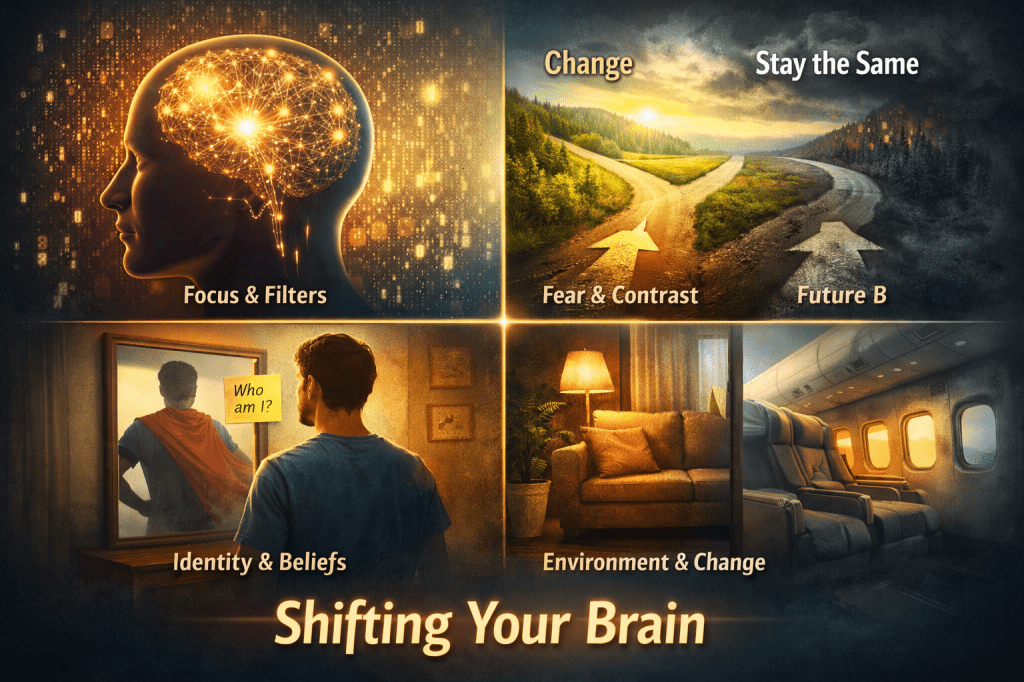
There Is a Formula for Brainwashing
And We Use It on Ourselves All the Time
I’m going to say something that sounds extreme, but stay with me.
There is a formula for brainwashing.
And most of us are already doing it, just not on purpose.
For years, I’ve watched clients struggle with the same question:
“I know what I should do. Why can’t I make myself do it?”
It’s not because they’re lazy.
It’s not because they lack discipline.
And it’s definitely not because they “don’t want it badly enough.”
It’s because the brain doesn’t change through motivation.
It changes through structure.
Once you understand that structure, behaviour change stops feeling mysterious.
Step One: How the Brain Decides What Matters
Your brain has a system called the reticular activating system, or RAS. Its job is not to show you reality.
Its job is to filter it.
At any given moment, you’re being bombarded with millions of bits of information, sounds, colours, movement, memories, bodily sensations. You consciously register maybe a few dozen.
Everything else is deleted.
What determines what stays?
Whatever your brain believes is important.
This is why when you buy a new car, you suddenly see that car everywhere. The world didn’t change. Your brain changed the filter.
It decided, this matters now.
This is also why vague intentions like “I just want things to be better” don’t work. There’s nothing for the brain to lock onto. No coordinates. No signal.
The brain can’t track a blur.
When people struggle with change, they’re often starting in the wrong place. They’re trying to push behaviour without giving the brain a clear target.
The brain needs specificity before it will engage.
Step Two: Why Fear Is Not the Enemy
This part makes people uncomfortable, especially in wellness spaces, but neuroscience is very clear.
The brain is not designed to make us happy.
It is designed to keep us alive.
That means it prioritises threat avoidance over pleasure.
We are far more motivated to move away from danger than toward reward. Loss aversion is stronger than reward anticipation, and we’ve known this for decades.
So when people only visualise success, they’re missing half the picture.
What actually creates movement is contrast.
The brain needs to see two futures:
One where change happens
One where nothing changes
Not abstractly. Emotionally.
For example, someone might imagine a future where they feel calmer, more stable, more present in their life. But they also need to imagine the other path. Same stress. Same exhaustion. Same conversations five years from now.
Here’s the part people rarely say out loud:
Doing nothing is still choosing a future.
When that future becomes emotionally real, something shifts. Staying the same starts to feel unsafe.
That’s not fear-mongering. That’s clarity.
Step Three: Identity Always Wins
Here’s a hard truth:
Your brain will violate logic before it violates identity.
People don’t fail at change because they don’t understand the logic. They fail because the behaviour they’re aiming for doesn’t match who they believe they are.
This is why willpower feels exhausting. You’re fighting the brain’s internal model instead of updating it.
Instead of asking, “How do I force myself to do this?” the more useful question is:
What kind of person wouldn’t even debate this behaviour?
When identity shifts, behaviour stops feeling like work. It starts feeling obvious.
In practice, this looks less like affirmations and more like rules:
What this kind of person believes
What they do by default
What they no longer negotiate
Not aspirations. Standards.
Step Four: Why Environment Beats Discipline Every Time
Most behaviour is not driven by values.
It’s driven by context.
Same person. Different environment. Different behaviour.
Your brain runs automatic scripts based on location, time, cues, and routine. That’s why you can be “strong” in one setting and completely fall apart in another.
It’s also why people change more easily on vacations than at home.
Novelty forces attention.
Attention creates plasticity.
Plasticity allows change.
I once worked with someone who stopped drinking simply by moving bedrooms while her house was being renovated. When the renovation finished, she didn’t want to move back. Not because the old room was cursed, but because that’s where the old script lived.
She wasn’t weak. She was conditioned.
Change the environment, and you interrupt the script.
That might mean rearranging a room, changing a routine, deleting an app, altering a schedule, or doing something small but unexpected. The goal is to make the brain say, this isn’t what I predicted.
That moment of surprise is where change becomes possible.
Why This Actually Matters
This isn’t about controlling yourself or becoming someone else.
It’s about understanding that the brain is always being shaped by what it repeatedly sees, fears, expects, and practices.
You can let that happen by default.
Or you can participate consciously.
The same mechanisms used to condition behaviour can be used to restore agency.
That’s the difference.
What all of this really comes down to is this: the brain is constantly deciding what matters, what feels safe, and what feels risky. It filters reality, protects identity, and runs on habit far more than intention. When people get stuck, it’s rarely because they don’t understand what they should do. It’s because their brain has been trained to look for the wrong signals, avoid the wrong threats, and repeat the same scripts in the same environments.
Once you understand that, change stops being a moral issue. It’s not about discipline or motivation or wanting it badly enough. It’s about precision, contrast, identity, and context. When those shift, behaviour often follows without the constant internal fight.
That’s the part most people miss. And it’s also where real agency lives.
 Caronleid