
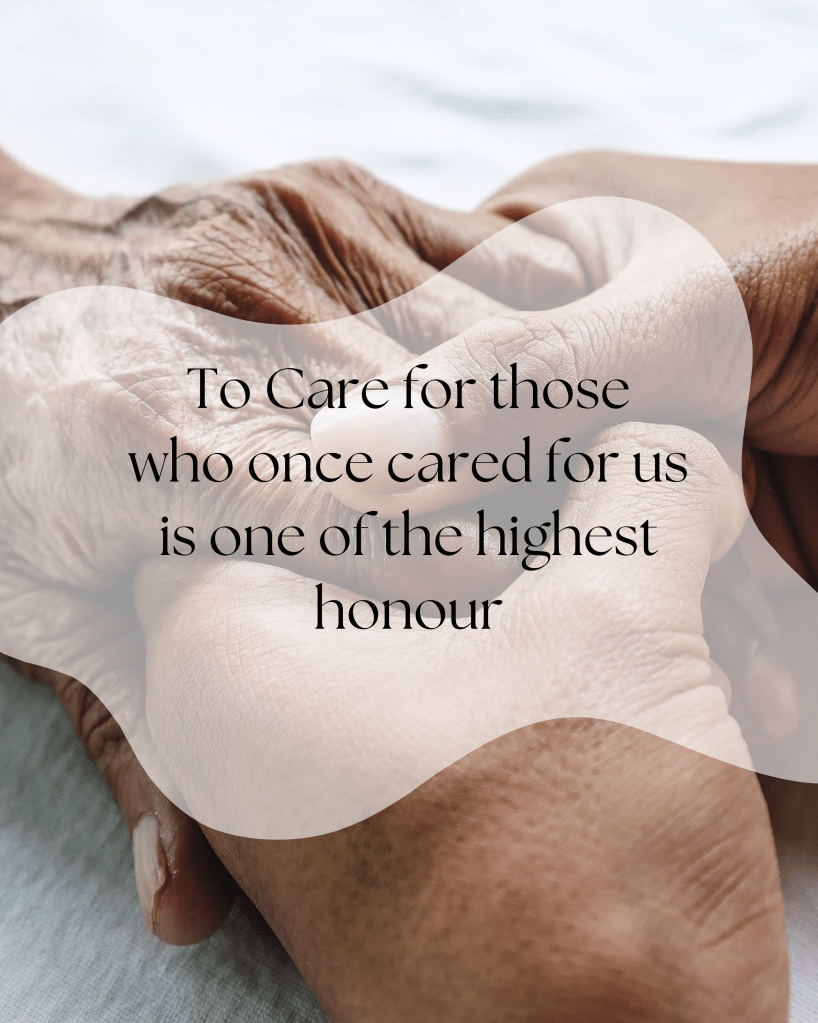
The definition of a caregiver, as I’ve come to know it, is an unpaid member of someone’s circle who helps with daily living. Simple on paper, but the reality is anything but. The responsibilities are enormous, the sacrifices constant, and yet the role itself is often invisible — underappreciated, misunderstood, and dismissed with the label “informal.”
I held that title for 20 years as the primary caregiver to my mom. She was diagnosed with Alzheimer’s at 57, the same year I had my only child. At 30 years old, I was suddenly sandwiched between caring for a newborn and caring for a mother with a terminal disease. That’s what they call the “sandwich generation,” a term first coined by Dorothy Miller and Elaine Brody in 1981. At the time, it referred to women in their thirties and forties. Now, as people live longer and caregiving stretches decades, men and women in their fifties and sixties are also being crushed in that sandwich.
Explaining what that actually looks like to someone who hasn’t lived it is nearly impossible. Specialist appointments, daily routines, medical crises, juggling work — it consumed my life. Fourteen months after my mom’s diagnosis, my dad died. Suddenly, I was her only caregiver. I kept her at home, worked full-time, raised my son, and hired a caregiver to fill the gaps. And for anyone thinking that makes it easier — it doesn’t. Every dollar I paid was the only reason I could keep working at all. The word “employed caregiver” sounds like a convenience. In reality, it was survival.
Back in 2004, researchers Bernard Van Denberg, Werner Brouwer, and Mar Koopmanschap wrote about the economic value of informal care. They pointed out what anyone in my position already knows: informal caregivers carry an enormous load in chronic and terminal illness, but their contributions barely register in policy or economics. Because we don’t come with a salary attached, we’re written off as “informal,” as if our labor costs nothing. But it does — in health, in opportunities, and in lost time we will never get back.
The numbers are staggering. Even with limited data, we know more than 8 million Canadians were providing care in 2012. Today that number is surely higher. Caregivers save the healthcare system $24 to $31 billion every single year. That’s not a typo. But those savings don’t come free. They’re built on our missed promotions, our reduced hours, our drained benefits, our broken sleep, our lost time with family and friends.
I made those sacrifices. I cut back work. I missed days. I turned down opportunities. And while the healthcare system celebrated the “savings,” I lived the costs.
And yet, when caregivers are mentioned at all, it’s usually in passing. One national caregiver day — most people don’t even know it exists. The truth is, we’re treated like an afterthought. People want to celebrate the idea of family care, but they don’t want to face what it costs the caregiver.
So yes, we all hope for a cure. But in the meantime, it’s caregivers holding up the weight of diseases like dementia. Which leaves me asking the same question I’ve been asking for years: Who actually cares for the caregiver?
References
Bernard van den Berg, Werner B. F. Brouwer and Marc A. Koopmanschap Source: Economic Valuation of Informal Care: An Overview of Methods and Applications The European Journal of Health Economics, Vol. 5, No. 1 (Feb., 2004), pp. 36-45 Published by: Springer Stable URL: http://www.jstor.org/stable/3570100
Brody, E.M. (1981). “Women in the Middle and Family Help to Older People”. Gerontologist. 21: 471–480.
Erosa, N., Elliott, T., Berry, J., & Grant, J. (2010). Verbal and physical abuse experienced by family caregivers of adults with severe disabilities. Italian Journal of Public Health 7,2, 76-84.
Gleckman, H. (2016). Can Family caregivers reduce hospital costs, Forbes.com, https://www.forbes.com/sites/howardgleckman/2016/06/10/can-family-caregivers-reduce-hospital-costs/#d29a94d77c69
Hartke, R.J., King, R. B., Heinemann, A. W., & Semik, E (2006). Accidents in older caregivers of persons surviving stroke and their relation to caregiver stress. Rehabilitation Psychology , 51,150-156.
National Alliance for Caregiving (2005). Young Caregivers in the U.S . Retrieved November 2, 2010, from http://www.caregiving.org/data/youngcaregivers.pdf
National Alliance for Caregiving and AARP. (2009). Caregiving in the US. Bethesda, MD: National Alliance for Caregiving.
National Opinion Research Center. (2014, May). Long term care in America: Expectations and realities. Retrieved from http://www.longtermcarepoll.org/PDFs/LTC%202014/AP-NORC-Long-Term%20Care%20in%20America_FINAL%20WEB.pdf
Navaie-Waliser, M., Feldman, P.H., Gould, D.A., Levine, C., Kuerbis, A.N. &, Donelan K. (2002) When the caregiver needs care: the plight of vulnerable caregivers. American Journal of Public Health , 92, 409-413.
Ory, M. G., Hoffman, R. R., 3 rd , Yee, J. L., Tennstedt, S., & Schulz, R. (1999). Prevalence and impact of caregiving: A detailed comparison between dementia and nondementia caregivers. The Gerontologist, 39 (2), 177-185. doi:10.1093/geront/39.2.177
Pinquart, M., & Sörensen, S. (2003). Differences between caregivers and noncaregivers in psychological health and physical health: A meta-analysis. Psychology and Aging, 18, 250-267.
Wassel, J.I. and Cutler, N.E. (2016). “Yet Another Boomer Challenge for Financial Professionals: The ‘Senior’ Sandwich Generation”. Journal of Financial Service Professionals. 70: 61–73.
Statistics Canada. 2012. “Portrait of Caregivers” http://publications.gc.ca/collections/collection_2013/statcan/75-006-x/75-006-2013001-6-eng.pdf
 Caronleid