
Growing up, my parents never gave me straight answers. If I came to them with a problem, or a question, or just that restless feeling that something wasn’t sitting right, they would tell me a story. A proverb. Something that sounded simple the first time you heard it and took days to actually unfold. You had to sit with it. Turn it over. Figure out what they were really saying underneath the thing they said out loud.
I didn’t always appreciate it at the time. It could be frustrating, honestly. You’d come looking for guidance and leave with a riddle. But somewhere along the way it rewired how I listen. It taught me to pay attention to the second layer, the part of any story that doesn’t get said directly, the meaning that lives just underneath the surface of the one being told.
That’s probably why Greek mythology got its hooks into me so young. Those stories worked the same way my parents did. They were never just about what they appeared to be about. A god wasn’t just a god. A journey wasn’t just a journey. Everything was carrying something else inside it, and the real question was always whether you were paying close enough attention to find it.
Icarus was the one that never let me go.
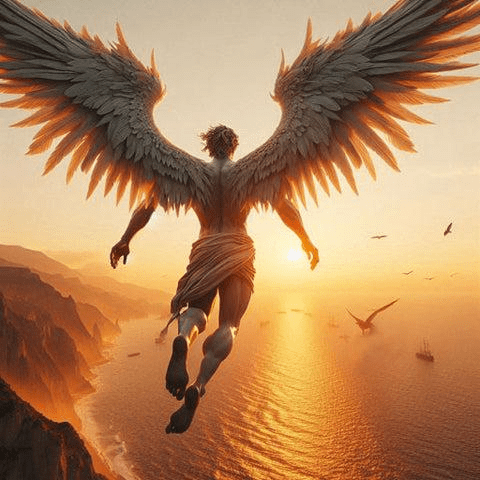
Most people know the broad shape of it. A boy, a pair of wings made from feathers and wax, a sun that didn’t care how badly he wanted to reach it. The wax melts. He falls. It gets handed down as a lesson about arrogance, about exceeding your limits, about what happens when you forget your place. That’s the version that survives.
The cautionary tale.
The hubris.
The fall.
But my parents taught me to listen for the part that doesn’t get told out loud.
Daedalus was not a man who ended up in prison by accident. He was the most gifted engineer and inventor of the ancient world, the kind of person whose mind ran so far ahead of everyone else’s that it got him into trouble more than once. King Minos of Crete hired him the way powerful people hire brilliant people, to solve a problem nobody else could solve.
The problem was the Minotaur, a creature half man and half bull, born from a curse, too dangerous and too shameful to be seen by the outside world. Daedalus built the Labyrinth to contain it. A maze so perfectly designed, so deliberately disorienting, that nothing that went in ever came back out.
The problem was that Daedalus knew too much. He knew the layout. He knew the solution. And when it served him to share that knowledge, he did. Minos found out. And instead of killing him, which might have been cleaner, Minos locked him in a tower with his son Icarus. You can keep a man’s body in one place. You cannot keep his mind there. Daedalus spent his imprisonment studying the one thing that surrounded him on all sides and couldn’t be taken away. The sky.
He built two pairs of wings. Feathers gathered over time, laid in rows from smallest to largest, held together with thread and shaped with wax. It was exactly the kind of problem he was built for. Not magic. Engineering. The same mind that designed an inescapable maze now designed the only exit from it.
Before they flew, he told Icarus two things. Don’t fly too high, the sun will soften the wax and the wings will come apart. And don’t fly too low, because the moisture rising off the sea will weigh the feathers down until they can’t carry you anymore. There is one altitude that works, he said. Stay in the middle. Keep adjusting. Pay attention.
In today’s world, Daedalus would be the parent who built everything from nothing, who carries the scar tissue of every mistake they ever made, who learned the hard lessons personally and doesn’t want to watch their kid repeat them. The one who sits you down before you walk into something big and says: I know what burns you out from the top and I know what drowns you from the bottom, I have seen both, here is the narrow path between them.
Don’t be reckless. But don’t be so careful that you never actually move.
Icarus already knew the theory. He had heard the warnings. He understood them, technically.
And then he felt what it was to actually fly, and the theory stopped mattering.
He went up. The wax softened. The feathers came apart. And the sea that his father had warned him about was right there waiting when he fell into it.
We remember the fall because it’s dramatic. We remember the sun because it makes a clean villain. What we leave out is that the sea was just as dangerous, and it was waiting for him from the beginning. We only ever tell the falling half of the story because hubris makes a better cautionary tale than mediocrity. A boy who flies too high is a tragedy worth retelling. A boy who never leaves the ground, or who stays so close to the surface that he vanishes without a sound, that story doesn’t get passed down. There’s no poem in it. There’s no drama. There’s just a person who played it safe and was forgotten.
My parents would have recognised that immediately. They would have wrapped it in something that didn’t sound like advice until three days later. But the shape of it would have been the same. The danger is in both directions. The only safe altitude is the one that requires you to keep adjusting.
I have been thinking about this because someone called me obsessive recently. Then they reconsidered and said extreme, as though that was a gentler word for the same thing. I haven’t been able to stop turning it over since, mostly because I couldn’t tell whether it was a warning or a compliment. That uncertainty is probably the answer.
I have seen what it costs to hold something too tightly. Whatever you’re trying to keep eventually starts taking pieces of you along with it. Somewhere between telling other people’s stories, writing my own, and trying to be useful to both, I stopped believing that balance was the thing to aim for. Balance always sounded like the right answer until I actually tried to live by it, and then it just felt like being lukewarm about everything.
The real choice feels simpler than that, and harder. You can move through your life half-committed, careful, leaving nothing behind that could embarrass you. Or you can go after something fully, knowing that devotion and destruction are not always easy to tell apart from the inside.
Fly low and drown quietly. Fly high and risk the fall.
The difference between all in and all consumed looks much larger from the ground than it does once you’re up there. One starves you slowly. The other erodes you, but at least something gets made in the process. The trick, if there is one, is to feel the wax beginning to soften before the feathers go. To know the difference between burning through something and being on fire. To make sure it’s the work you’re feeding and not the part of yourself that cannot grow back.
My parents spoke in parables because they understood that the most important things don’t land when you say them directly. You have to come to them yourself. The story of Icarus worked the same way on me. I read it looking for one thing and found something else sitting quietly next to it, waiting.
Everyone remembers that Icarus flew too close to the sun. Almost no one remembers he was also warned not to disappear into the sea.
The fall is not the only way to lose.

